.png)

September 15, 2026

6 Leadership Development Approaches Compared | Group Coaching HQ
September 15, 2026
Dominique Mas, PCC
Which Leadership Development Approach Is Right for Your Organization? 6 Options Compared
Workshops, AI coaching, one-to-one coaching, internal programs, external leadership programs, and group coaching... What is each one actually good at? And where does each one fall short?
There is no single best leadership development approach. Workshops, AI coaching, one-to-one coaching, internally built programs, external leadership programs, and group coaching each solve a different problem. The right choice depends on several things:
- the size and seniority of the population you are developing
- the outcome you’d like to achieve (e.g. better delegation, better collaboration etc.)
- how many hours your internal team can realistically give
- the timeframe for implementing the program.
Disclosure
This comparison was written by Group Coaching HQ. We train internal and external coaches and we deliver group coaching programs to organizations, so we have a commercial interest in some of the six approaches below.
We have tried to counter that in three ways: by stating our comparison criteria before we compare anything, by naming the conditions under which each of the other five approaches is the better choice, and by including a section on where group coaching is the wrong answer. If you only read one part of this page for a sense of whether it is fair, read that last section.
The short answer
There is no single best leadership development approach. There is a best approach for a given population, a given outcome, and a given amount of internal capacity.
As a rough guide:
- One-to-one coaching is the strongest option for a small number of senior or high-stakes individuals.
- AI coaching is the strongest option for reaching a very large population at low cost, where the goal is practice and support in the moment rather than long term behavior change.
- Traditional workshops are the strongest option for introducing shared frameworks or vocabulary quickly.
- Internally built programs are the strongest option when you have real internal capacity and want development that is deeply specific to your business over the long term.
- External leadership programs are the strongest option for senior audiences where credential, prestige, and outside networks are part of the value.
- Group coaching is the strongest option for the middle of the organization: managers, high-potentials, reaching 50 or more people while building connection, where you need sustained application and peer learning.
Most organizations end up running several of these at once, aimed at different populations. The problem is using one approach for a population, outcome, or timeframe it was never designed to serve.
How we chose what to include
We included an approach if it met all three of these tests:
- It is typically funded from a learning, talent, or people budget as a distinct line item, rather than absorbed into general management overhead.
- It is available to an organization without building new infrastructure first. You can buy it, or stand it up, within a normal planning cycle.
- Its stated purpose is leadership or manager capability, not technical or functional skill.
What we deliberately left out, and why:
- Mentoring programs and rotational assignments. Both develop leaders, and both are worth running. They are excluded because they draw on internal senior capacity rather than a development budget, which makes a like-for-like comparison on cost and internal lift misleading.
- E-learning libraries and content subscriptions. These are a distribution channel for content rather than a development method. Several of the approaches below can be delivered through one.
- Conferences and industry events. Valuable for exposure and networks; not structured to produce behavior change in a defined population.
- Individual assessments (360s, psychometrics). These are inputs to development, not a development approach on their own.
Reasonable people would draw these lines differently. If you think we excluded something that belongs here, that is a fair objection to the comparison.
What we mean by "impact," "internal lift," and "scalability"
These three words get used loosely, so here is what they mean on this page.
Impact means sustained change in how someone leads, visible on the job weeks or months after the program ends (think retention, measurable efficiency). It does not mean participant satisfaction scores, completion rates, or self-reported confidence. Those can be easy to move and might not be exactly correlated with what you are buying.
Internal lift means the hours your own HR, talent, or L&D staff spend getting the program launched and keeping it running: sourcing, scheduling, chasing attendance, managing facilitators, handling communications, reporting. This is the cost most organizations underestimate, because it does not appear on an invoice.
Scalability means what happens to cost and effort as you add the hundredth participant. An approach is highly scalable if the hundredth participant costs roughly what the tenth did.
The comparison at a glance
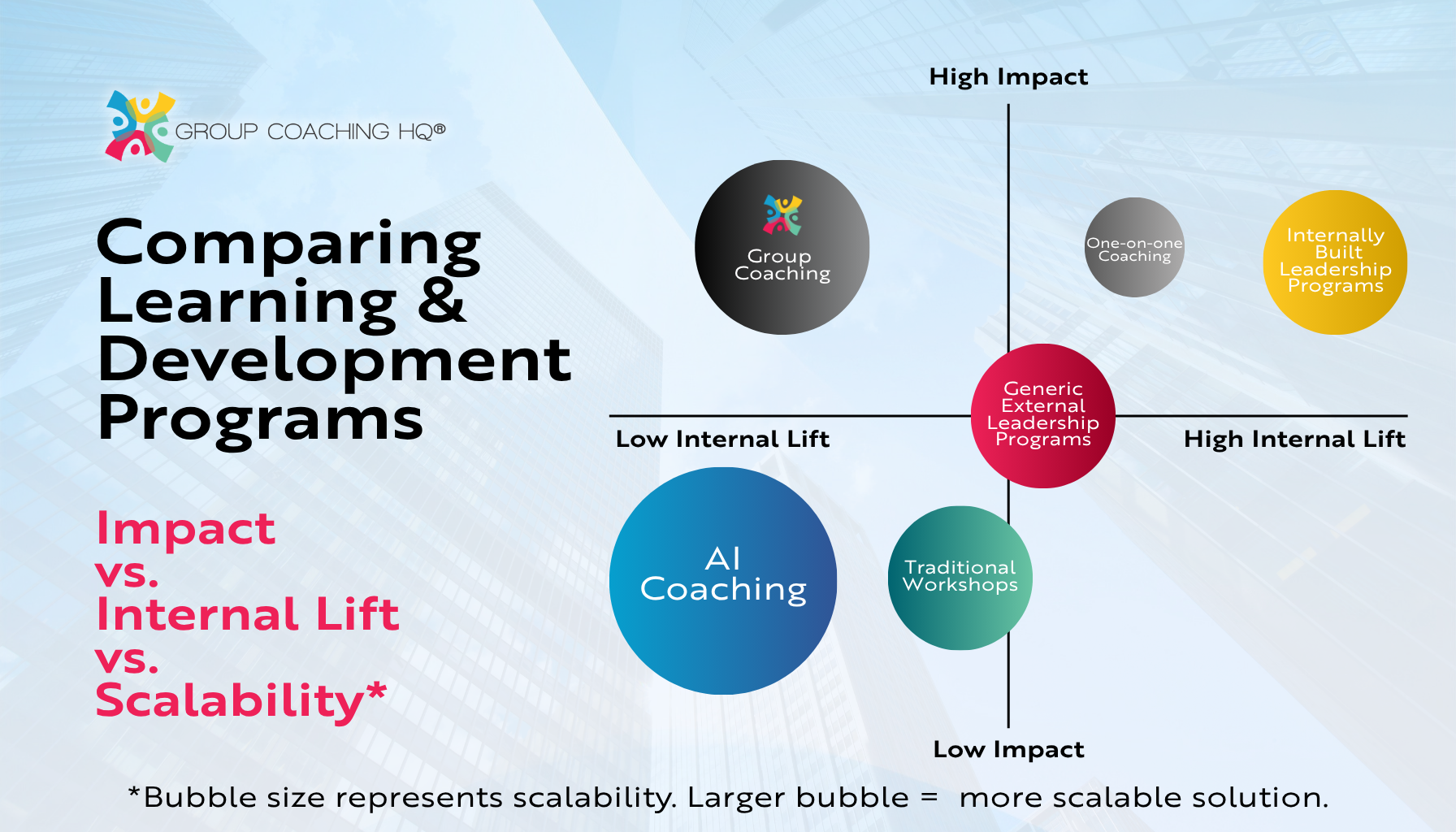
Traditional workshops
What it is: A facilitated session or short series, usually half a day to two days, delivered to a group around a defined topic such as giving feedback, difficult conversations, leading through change.
Where it is strongest
Workshops are often used for installing a common vocabulary quickly. If you need 300 managers to share the same definition of a good one-to-one by the end of the quarter, a workshop rollout is the right instrument. Workshops are also the most efficient way to introduce a new framework, and they create a useful visible moment that signals organizational commitment.
Where it falls short
Application. A workshop transfers knowledge on a Tuesday and then returns people to a workload that has not changed. Without structured follow-through, most of what was learned is not practiced, and what is not practiced does not stick. Workshops also compress individual difference. The manager struggling with a specific underperformer and the manager struggling with a peer conflict sit through the same content.
Choose this when
You need breadth and speed on a defined topic, and you have a mechanism for follow-through, or you accept that awareness is the outcome you are buying.
AI coaching
What it is: Software-delivered coaching conversations, available on demand, usually combining reflective prompting with content recommendations and progress tracking.
Where it is strongest
Reach and cost. AI coaching is probably the only approach here that can serve an entire employee population without a proportional increase in budget. For repeated low-stakes practice (e.g. rehearsing a message, thinking through a decision, getting a nudge between other development activities) it is genuinely useful, and it is improving quickly.
Where it falls short
Anything relational. AI coaching cannot create peer accountability, cannot connect two managers in different offices who are solving the same problem, and cannot build the cross-functional relationships that are often the real reason an organization runs leadership development in the first place. Engagement is also a recurring issue: usage may lean toward people who were already self-directed. And in an environment where employees already report increasing isolation, a development strategy that is entirely software-mediated carries a cost that does not show up in the per-seat price.
Choose this when
You need to reach a very large population, budget per head is tight, and the outcome you want is individual reflection and practice rather than organizational connection. Also strong as a layer underneath something else.
One-to-one coaching
What it is: A certified coach working with one individual over a defined engagement, typically six to twelve sessions.
Where it is strongest
Depth. A single coach with a single client can go anywhere the client needs to go, at whatever pace, with complete confidentiality. For an executive navigating a role transition, a high performer who has become a liability to a team, or a leader dealing with something they will not say out loud in a room with peers, one-to-one coaching is the correct answer and no group format substitutes for it.
Where it falls short
Economics and reach. One-to-one coaching is the most expensive option per participant by a wide margin with an average price of $234 per hour according to the ICF in 2026, which is why in most organizations it stops at the top two or three layers. That creates a familiar pattern: the executives who need coaching least get the most of it, while the frontline and mid-level managers who touch the majority of employees get a workshop. One-to-one coaching also produces no lateral connection. Six individually coached leaders are six better leaders, not a better-functioning leadership team.
Choose this when
The stakes are individual and high, the population is small, confidentiality matters, or the situation is genuinely idiosyncratic.
Internally built coaching or leadership programs
What it is: A program your own team designs and runs, often using internal facilitators, internal coaches, or a licensed framework adapted in-house.
Where it is strongest
Specificity and ownership. Nobody understands your business, your culture, and your actual leadership challenges better than your own people. An internal program can use real cases, reference real decisions, and evolve with the strategy. Over a long enough horizon and at sufficient volume, it is also the cheapest option, because the design cost amortizes.
Where it falls short
Capacity, consistency, and fragility. IInternal builds tend to carry the highest internal lift of any option since your team has to handle the design, facilitator development, scheduling, quality control, and iteration. Most talent teams are already at capacity, so the program competes with everything else on their plate and tends to slip. Quality varies with who is facilitating and these programs are often dependent on one or two people. When they leave or get reassigned, the program frequently stalls. There is also a confidentiality ceiling: participants disclose less to an internal facilitator who sits in the same organizational hierarchy.
Choose this when
You have genuine dedicated internal capacity, a large enough population to justify the build, and a multi-year commitment.
Generic external leadership programs
What it is: Open-enrollment or lightly customized programs from business schools, established leadership institutes, and large training providers.
Where it is strongest
Credibility and outside perspective. A recognized program carries a name that matters in retention conversations and succession discussions. Participants meet peers from other industries and return with genuinely outside reference points. Faculty are often excellent, and the research base behind established programs is real.
Where it falls short
Relevance and cost. Content built for a general audience is, by construction, not built for your audience. Participants have to do the translation work themselves, and many do not. Cost per participant is high enough that these programs are usually rationed to a small senior group, which limits organizational effect. And because participants attend as individuals rather than as a cohort from your organization, very little of what they learn moves laterally when they return.
Choose this when
The credential has internal value, and exposure to leaders outside your organization is part of what you are buying.
Group coaching
What it is: A trained coach working with a small cohort, typically six to ten people, over a series of sessions. Unlike a workshop, the agenda comes from the participants' live challenges rather than from a content deck. Unlike one-to-one coaching, participants coach each other with the coach's support.
Where it is strongest
The combination that the other five approaches force you to trade between. Group coaching produces application-level depth, because participants work on real current problems over time rather than hypothetical cases in a single session. It produces lateral connection, because a cohort of managers from different functions or offices builds working relationships as a side effect. And it scales in a way one-to-one coaching cannot, because one coach serves six to ten people at once, which usually places the per-participant cost between a workshop and one-to-one coaching. When delivered by an external partner, internal lift stays low: coach sourcing, cohort design, communication and onboarding, and reporting sit outside your team.
Where it falls short
Group coaching depends on the group. It needs psychological safety, and it needs participants who will speak candidly. Facilitation quality is the single biggest variable. A skilled group coach and a workshop facilitator running a discussion produce very different outcomes, and the market does not distinguish between them clearly. Group coaching is also slower than a workshop rollout: cohorts run over weeks or months, so it is a poor fit if you need everyone to know something by a fixed date.
Choose this when
The population is the middle of your organization, or the outcome you want is applied behavior change plus cross-organizational connection.
Where group coaching is the wrong answer
We say this to prospective clients, so it belongs here too. Do not choose group coaching if:
- The population is your executive committee. Senior leaders might not be fully open to sharing their individual challenges, a pre-requisite for group coaching. One-to-one coaching or team coaching are the better instruments.
- The issue is confidential or performance-related. Anything involving a specific individual's performance, a formal process, or something the participant would not want a peer to know does not belong in a group.
- You need everyone trained by a deadline. Cohort-based work does not compress. Use a workshop rollout.
- You are trying to fix a structural problem. If managers are failing because spans of control are unmanageable, incentives are misaligned, or the operating model is broken, coaching will produce more self-aware managers inside the same broken system. Fix the structure.
- Participation is mandatory and resented. Group coaching requires willing engagement more than any other format on this list. A cohort of people who were volun-told will not produce much.
- The group cannot be kept confidential. If participants report to each other, or if what is said in the room is likely to travel, candor will not appear and neither will the outcome.
Five questions that usually settle the decision
- How many people, and at what level? Under 20 senior people points toward one-to-one or an external program. 50 to 500 in the middle layers points toward group coaching, workshops, or AI coaching.
- What has to be true afterward? If the answer is "they know the framework," a workshop is sufficient. If it is "they behave differently under pressure," you need something that runs over time.
- Do you need people connected to each other, or just individually better? This question alone eliminates half the list. AI coaching and one-to-one coaching produce individual improvement with no lateral effect.
- How many hours can your team actually give this? Be honest, and count the recurring hours, not the launch. If the honest answer is under five hours a month, an internal build will not survive.
- Is this a one-time initiative or a repeating capability? One-time favors buying. Repeating and large favors building, at least eventually, and perhaps partnering in the shorter term.
How these approaches stack
The most effective portfolios we see are not single-modality. A common structure in organizations:
- Executive layer: one-to-one coaching, plus an external program where the credential matters.
- Mid-level managers and high-potentials: group coaching cohorts, which is where scale and depth both matter.
- All managers: a workshop rollout for shared vocabulary, and AI coaching underneath as always-available reinforcement.
The approaches are not competing for the same job. They are competing for the same budget, which is a different problem, and one that usually resolves once you are explicit about which population each line item serves.
Frequently asked questions
Is group coaching just a workshop with a smaller group? No. A workshop works from a prepared agenda toward defined content. Group coaching works from what participants bring, and much of the value comes from participants working on each other's problems. The facilitator skill sets are different, and so are the outcomes.
Can AI coaching replace human coaching? Not yet, and not for the relational outcomes. It is a strong complement for reinforcement between human sessions, for reach into populations you could not otherwise serve, and for on-demand practice. It does not build peer accountability or cross-functional relationships.
How do you measure whether any of this worked? Ask for the measurement design before the program starts. Useful measures are behavioral and observable: manager effectiveness scores from direct reports, retention in the participating population against a comparison group, internal promotion rates, and specific applied changes participants can name.
What does group coaching typically cost relative to one-to-one coaching? Per participant, meaningfully less, because one coach serves eight to ten people over the same period. The precise ratio depends on cohort size, session count, and coach seniority, so treat any single published figure with suspicion and ask providers to show the math for your actual cohort design.
We already run leadership training. Does this replace it? In most organizations group coaching extends existing training deeper into the organization and adds the application layer that training alone does not provide. It’s perfect complement to it, or continuation.
About this page
Group Coaching HQ delivers group coaching programs for organizations, including coach sourcing, cohort design, session delivery, participant onboarding, impact measurement, and wrap-up reporting. Our approach is built on The DOLIX Model®, and our group coaching certification program is accredited by the International Coaching Federation (ICF).
We produced this comparison because our buyers asked the question and we could not find a version of the answer that was not a sales page. We are one of the six options above and we have said where we are the wrong choice. If you think we have been unfair to one of the other five, tell us and we will correct it.
Sources cited on page: Group Coaching HQ, The DOLIX Model®. International Coaching Federation, accreditation overview.
Build the skills that make the difference in the room
"Create Impactful Group Coaching Programs" covers essential steps and strategies needed to build successful coaching cohorts. This e-book is perfect for coaches looking to expand their influence and design transformative group coaching experiences. Download your free copy to explore practical advice and proven methodologies that guide the creation of group coaching programs.
m