.png)
%20(2).png)

August 21, 2026
.png)
Group Coaching Belongs at the Center of the New CHRO Agenda
June 2, 2026
Dominique Mas, PCC
I’ve been having a lot of conversations with Talent and L&D leaders lately and what seems clear is that their strategy conversation has changed. For years, organizations could rely on a familiar playbook: hire where talent was available, train people for today’s roles, offer leadership programs to high potentials, and adjust organizational design when the business required it. Unfortunately, many disruptions mean that playbook is no longer enough.
Two recent reports I’ve read make this clear. Bain & Company’s The Great Talent Recalibration: How Macroeconomic Shifts Are Reshaping the CHRO Agenda, by Karen Harris, Susan Gunn, and John Hazan, argues that talent leaders are facing a fundamentally different environment shaped by post-globalization, capital scarcity, demographic decline, and the decreasing cost of distance. The authors write that the CPO role is expanding as organizations rethink how they access, develop, and deploy talent.
The World Economic Forum’s Chief People Officers’ Outlook: May 2026 points to the same shift from another angle. CPOs report that the most acute challenge is now talent matching and access to critical skills. They also identify reviewing organizational structure and job design, expanding upskilling and reskilling (in other words, internal mobility), and supporting AI and automation deployment as top workforce priorities.
Together, these reports point to one conclusion: organizations need development strategies that are scalable, relational, adaptive, and close to the work. That is exactly where group coaching in organizations becomes a strategic lever.
The talent problem is becoming a skills-and-adaptability problem
Bain’s report highlights demographic decline as one of the most profound forces shaping the future workforce. Working-age populations are shrinking in major economies, and the report notes that companies will not be able to meet talent needs through hiring alone: they need to develop more of the people they already have.
Group coaching programs are particularly well suited to this moment because they create shared development experiences around real work challenges. Unlike one-off training, group coaching does not assume that learning happens because content was delivered. Instead, participants bring current challenges into a structured, confidential space where they reflect, practice, receive peer perspective, and leave with action.
This matters because the WEF report emphasizes that skills-based workforce strategies can help bridge the talent-matching gap. Group coaching supports exactly that shift. It helps employees translate learning into changed behavior, while also surfacing what skills are actually needed in the day-to-day work.
AI adoption requires more than training
The WEF report notes that 83% of chief people officers expect their organizations to be in the scaling phase of AI deployment within the next 6–12 months. But the report also warns that positive gains depend on changes in role design, performance management, and talent processes, not just individual upskilling.
This is a critical insight for L&D leaders. Mandatory AI training alone will not create AI-ready organizations. People need space to make sense of how AI changes their role, their judgment, their relationships, and their contribution.
Group coaching gives organizations a practical way to support this transition. A cohort of managers, for example, can explore questions such as:
- How do we lead when AI changes the work faster than job descriptions can keep up?
- What decisions still require human judgment?
- How do we keep trust, empathy, and accountability alive in increasingly automated workflows?
Bain’s report raises a similar question: “When do we need a human?” It notes that while AI may deliver technically correct answers, humans provide empathy, judgment, trust, nuance, and lived experience in complex decisions. Group coaching strengthens those human capabilities at the same time organizations are investing in technological ones.
Hybrid and distributed work demand stronger connection
Bain also identifies the decreasing cost of distance as a force reshaping work. Remote work has stabilized at roughly 20%, while office occupancy remains around 50% of pre-Covid levels. The report notes that hybrid work expands access to talent but creates challenges for apprenticeship, cohesion, and culture.
This is one of the clearest business cases for group coaching.
In hybrid and distributed environments, employees may be connected through systems but disconnected from each other’s experiences. They may attend meetings all day without ever having the kind of conversation that builds trust, perspective, or belonging.
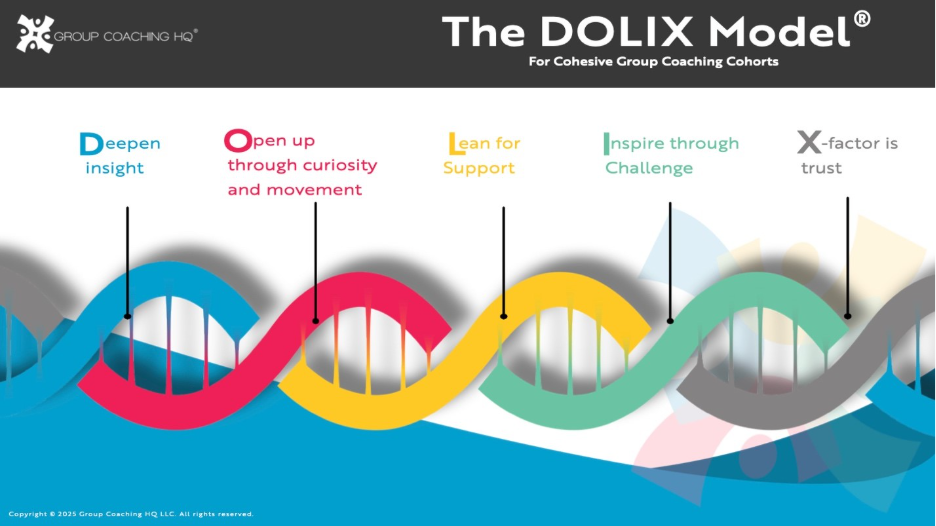
At Group Cocahing HQ, we have seen first hand how well-designed group coaching programs create intentional spaces for that deeper connection. Participants hear how peers in other functions, regions, or teams are navigating similar pressures. They realize they are not alone. They practice listening, asking better questions, and challenging assumptions. Over time, this strengthens the connective tissue of the organization. Our DOLIX Model® is a testament to this!
Group Coaching HQ’s 2026 landscape study found that current group coaching programs are most often used to accelerate leadership development, develop high-potential talent, and foster peer learning and accountability. It also found that active programs often converge around cohorts of 5–8 participants meeting monthly for 90 minutes over four to six months. That structure is not accidental. It gives people enough continuity to build trust and enough space to apply learning between sessions.
The CPO role is becoming an ecosystem role
The WEF report argues that geopolitical and geoeconomic disruption is now directly affecting workforce planning. Organizations are responding by strengthening internal mobility, rapid redeployment, diversified talent hubs, and continuous learning models. The report also emphasizes a shift from competing for talent to collaborating on talent.
This is where group coaching programs can serve more than individual development. They can become a mechanism for workforce agility.
Imagine cohorts designed around strategic transitions: new managers leading through AI adoption, high-potential leaders preparing for regional expansion, or cross-functional groups navigating restructuring. In each case, group coaching helps the organization build capability while also creating stronger internal networks.
That network effect matters.
When participants from different divisions learn together, they gain a broader view of the business. They build relationships outside their silos. They begin to understand how decisions ripple across the organization. This is the kind of relational infrastructure that helps organizations redeploy talent, share knowledge, and adapt faster.
The benefits of group coaching are strategic, not just developmental
The strongest case for group coaching in organizations is not that people enjoy it, though many do when it’s led by our coaches or coaches we have trained! 😆. The stronger case is that it addresses multiple CHRO priorities at once.
✅ It scales coaching access beyond senior executives.
✅ It supports leadership development during critical transitions.
✅ It strengthens peer learning and accountability.
✅ It builds connection in hybrid work.
✅ It helps employees apply new skills to real challenges.
✅ It develops the human capabilities that AI cannot replace.
The Group Coaching HQ landscape study also found that the biggest barrier to expansion is not skepticism about value, but implementation confidence: trained facilitators, proven templates, ROI evidence, and business-case language. That is an important distinction. The question is no longer whether group coaching has a place in organizations. The question is how to design and scale it well.
What L&D and coaching leaders should do now
To make group coaching programs work in this new environment, we encourage organizations to start with a clear business need. New managers, high-potential leaders, AI adoption cohorts, internal mobility groups, and change-readiness cohorts are all strong use cases.
Next, design for shared context. Group coaching works best when participants have enough in common to relate to each other, and enough diversity to expand perspective.
Then, invest in trained group coaches. Facilitating a group coaching conversation is not the same as coaching one-on-one or delivering a workshop. Coaches need to know how to hold psychological safety, manage group dynamics, invite challenge, and support peer accountability.
Finally, measure what matters. Track participant application, behavior change, manager feedback, retention signals, internal mobility, engagement, and qualitative stories of impact. In a capital-constrained environment, group coaching needs both a values case and a business case.
The future of work will be shaped by AI, demographic pressure, geopolitical complexity, and changing employee expectations. Make sure your organization develops people fast enough, connects them deeply enough, and helps them adapt together. We deeply believe that this is what success will look like as opposed to simply more automation.
That is the promise of group coaching in organizations: scalable development that keeps the human advantage at the center of workforce transformation.
We look forward to hearing your thoughts on this topic!
Turn Workforce Challenges into Coaching Opportunities
Today's CHROs are being asked to develop more people, adapt faster to change, and strengthen connection across increasingly complex organizations. Our free ebook explores how group coaching can help you expand coaching access, build leadership capability, foster peer learning, and create a stronger coaching culture without relying solely on 1:1 coaching. Download your copy to discover practical strategies and real-world applications for group coaching in organizations.
m
