.png)
What Coaching Changes in Law Firms
What does it take to introduce coaching into a profession built on expertise, billable hours, and high-performance expectations?
With
Traci Mundy Jenkins
Director of Career Development
Venable
May 26, 2026




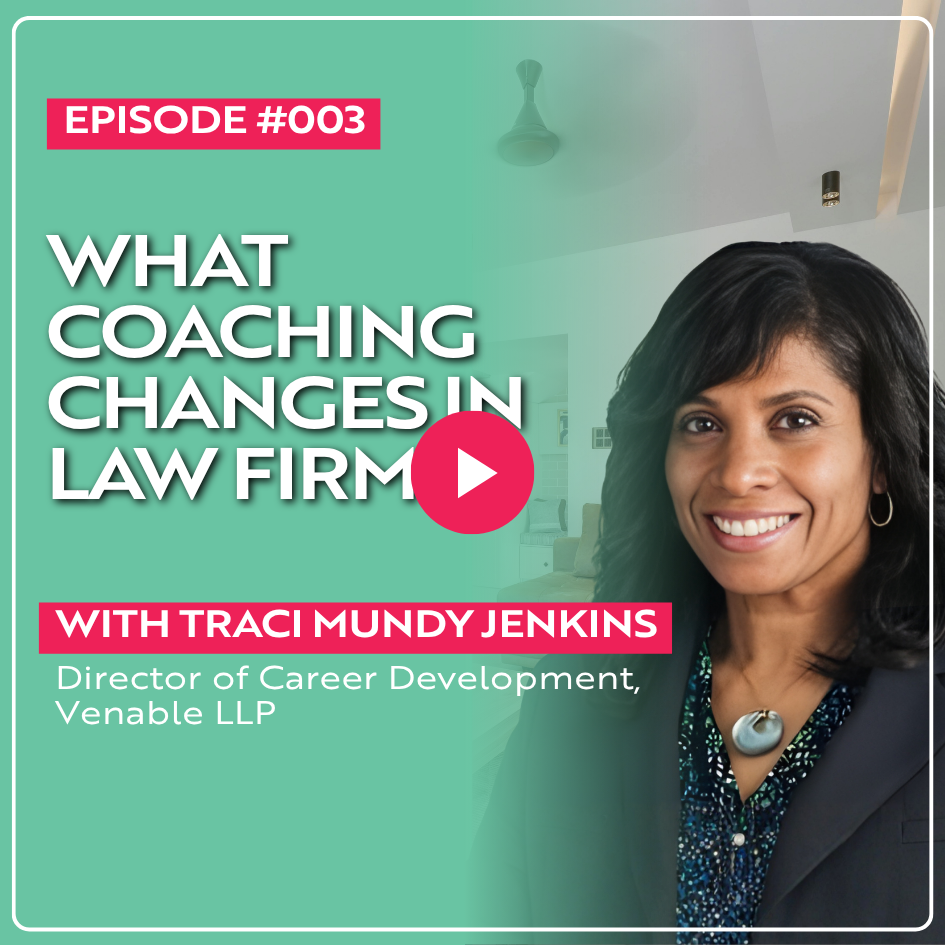
What does it take to introduce coaching into a profession built on expertise, billable hours, and high-performance expectations?
In this episode of the Group Coaching in Organizations Podcast, Traci Mundy Jenkins, Director of Career Development at Venable, shares how coaching is being integrated into the development of legal professionals. Drawing on her background as a lawyer, legal recruiter, and career development leader, Traci explains how she discovered coaching and began applying it to conversations she was already having with associates and partners.
You’ll hear how Venable piloted a group coaching program designed to support lawyers transitioning toward partnership, why preparation and expectations are critical before the first session begins, and how group coaching creates powerful peer learning across offices.
If you’re passionate about coaching cultures, internal coaching, or expanding group coaching inside professional services organizations, this episode is a must-listen.

04:25 - Traci’s Origin Story in Coaching: Traci discusses her journey into coaching, highlighting her enjoyment of engaging with people.
05:33 - Cultivating a Coaching Culture at Venable: Traci shares how her background informs the coaching culture at Venable, emphasizing support for associates and managers.
09:05 - The Balance of Advising and Coaching: Traci explains the difference between advising and coaching and how this impacts her program design.
11:23 - Designing Group Coaching for Counsel: Traci details why she chose to create a group coaching program for counsel on the partnership path.
16:46 - Practical Program Design and Structure: Traci outlines the practical aspects of her program design, including outreach and session structure.
22:02 - The Value of Pre-Meetings in Program Success: Traci explains why one-on-one pre-meetings are essential for participant understanding and commitment.
24:38 - Fostering Peer Coaching and Engagement: Traci discusses the challenge of ensuring participants coach each other and ideas for improving engagement.
29:00 - Flexibility in Program Delivery: The Imposter Syndrome Story: Traci recounts a session where an unexpected turn in discussion led to important learning.
32:50 - Becoming Comfortable with Silence: Traci shares her experience as a lawyer learning to tolerate and appreciate silence in coaching sessions.
36:00 - Protecting Reflection Time in Coaching Programs: Traci talks about the importance of building in dedicated time for reflection to enhance learning retention.
Traci Mundy Jenkins is the Director of Career Development at Venable, where she leads initiatives supporting the professional growth and career progression of approximately 300 associates across the firm.
Her work focuses on helping lawyers navigate career transitions, strengthen leadership capabilities, and build sustainable careers within a demanding profession. She integrates coaching approaches into her work with associates, partners, and firm leadership.
Prior to returning to Venable, Traci served as Assistant Dean for Career and Professional Development at American University Washington College of Law and co-founded a legal recruiting and consulting firm. She has also served as President and board member of the National Association for Law Placement.

Dom Mas: Hi, you're listening to the Coaching in Organizations podcast, real stories and strategies for building coaching cultures within organizations, with an unapologetic love of group coaching. I'm your host, Dominique Mas, and I'm the founder at Group Coaching HQ.
Today my guest is Traci Mundy Jenkins, Director of Career Development at Venable. Traci joined our group coaching certification program back in the spring of 2023, and I've been following her adventures ever since. As she started implementing group coaching programs at the firm, I am in awe of the intentionality she puts into this work. In this episode, we reflect on what it takes to introduce coaching into a profession built on expertise, billable hours, and high performance expectations.
Specifically, we focus on how group coaching supports identity transitions for lawyers preparing for partnership, how preparation for an orientation and expectation setting drives engagement in coaching programs. We also talk about the importance of building cross-office groups to support networking and relationship building. Finally, we dive into why peer learning and peer coaching is the real engine of group coaching. Enjoy the conversation.
Hi Traci, welcome to the Coaching in Organizations podcast.
Traci Jenkins: Thank you for having me.
Dom Mas: I'm very excited. Before we dive into our conversation, though, I would like to share a little bit about you, and then you can tell me if I missed anything. I was rereading this before we started, and I just, I'm in awe of all the things that you have done. So let me, let me name them for everybody. You're a certified group coach, and you're the Director of Career Development at Venable, where you created a program for approximately 300 associates to support their career progression.
You're part of the professional development and training department, and you're involved with the onboarding and integration of recent law students graduate, or law school graduates, sorry, and lateral associates through individual advising, coaching, small group discussions, presentations on critical professional skills, and also highlighting the firm's wellbeing initiatives. You have your hands full.
In addition to this, you also offer guidance to partners and other firm leaders to assist with their associate interactions. And I love that you have this thing about education too, because prior to returning to Venable in 2018, where you had actually started your legal practice as a commercial litigation associate, you were the Assistant Dean for Career and Professional Development at American University Washington College of Law. So I love that because there you were working with law students and alumni on all aspects of their career advancements, and you were also a co-founder and managing partner at a legal recruiting and consulting company.
Traci Jenkins: Yes.
Dom Mas: Not done yet. You're also a former president and board member of the National Association for Law Placement, and you've held leadership positions in other professional community and organizations. Because of all this amazing work, you're a frequent speaker on a variety of career and professional development topics. So I am so happy to have you here. Did I miss anything?
Traci Jenkins: No, you really didn't. You did pick up on the full circle moment for me in terms of starting my career at Venable and having all these wonderful experiences and being able to bring so much of that back to the firm. So it's been a really nice journey so far.
Dom Mas: Well, I'd love to hear even more of that journey. If you wouldn't mind sharing a little bit about your origin story. How did you get into coaching?
Traci Jenkins: Yes. And I think everything you touched on has a common theme, which is I just enjoy engaging and interacting with people. And so I did that on the law school level with our law students, with alumni. I do it now on the associate level primarily, but also with our counsel. And it's just been wonderful to hear their stories, help them think about, are there different ways that they could approach what they're doing? Certainly, if they have challenges, helping them to just sort of get out of their own way. They know the answers a lot of the time. So I figured that coaching just adds this other layer to everything that I was doing, to the engagement, to the listening, and really just gave me some very tangible tools that I could use that could be helpful as I'm interacting with them. And I also work with pre-law students, those outside of the legal industry. It's just coaching is just such a nice way to have that type of interaction.
Dom Mas: Thank you for sharing that. And I know even from the little I know you, I can recognize that joy for being in community and for supporting others. And I'm curious, as you are leading the coaching and developing the coaching culture at Venable, would you share a little bit about that, about what that looks like and how actually your experience has informed the development of this coaching culture?
Traci Jenkins: Yes. So this position that I hold now is the first time they've ever had someone who was really focused as initially an internal advisor and now both an advisor and a coach. And I feel like that really is a testament to Venable and the coaching culture because it understands the importance of really using those skills to help individuals progress. If they're progressing well, if they're doing good work, it's going to benefit the firm. And so at the end of the day, having someone in my place that is really there primarily to support our associates is just a great development tool. And when I started in this position, you noted eight years ago, there weren't too many internal advisors. And if they were in place, a lot of them focused on outplacement, so the transition if an associate was leaving. And I feel this support is different from that. Now, certainly, there may be associates. We know that being at a big law firm, some associates, it's just not the environment for them at certain points in their lives. So I do help them if they're interested in that transition. But my primary responsibility is to make sure that they are progressing the way they want. They're using their skills. They're able to have those internal connections. And so Venable, I think, fostered that through my position, but also our managers. In fact, we have what we call a manager summit going on tomorrow and also today. And they've had several coaching programs that really help the managers make sure that their teams, individuals on their teams, are really functioning in a way that makes everyone more effective, both from a team level and also from an individual level. So I feel like that coaching culture is in place at just different levels.
Dom Mas: I love hearing that. Thank you. I think one of the things that we often, and you and I kind of exchanged through email about this, often we think of coaching cultures as like, how many coaches are there? What are the number of programs running? But really, the coaching culture is measured in behaviors and how many people are using coaching skills day to day. Are these managers supporting the growth of their people, or are they always telling them what to do? I think that's what makes a coaching culture. So what you share is music to my ears.
Traci Jenkins: I totally agree with that. It is, those tools are so valuable. And if you use them correctly, you really can gain better insight into what your team members are thinking, and also how can they work together or even independently to achieve the goals that you've set out for your department.
Dom Mas: Yeah. And you know I'm so curious because I think that's something that a lot of internal coaches are dealing with. We talked a little bit about the spectrum between advising and coaching before. And I'm curious what your take on it is and how this distinction impacts the way that you end up designing coaching programs in the organization.
Traci Jenkins: Yes, it's such a good point, especially for those who are internal and do wear a couple of different hats. There are some times when associates just need the answer. I'm a resource. They need the answer. I try to give them the answer. And so that is pure advising. There are other times when it's a hybrid. So they'll share something with me. We'll delve a little deeper. I'm listening. I'm asking them questions so they can be self-reflective. But then maybe in the middle of the conversation, there's another question. And so that's not a true coaching relationship. So those experiences have really helped me when I do have that true coaching relationship to really be intentional about it. So really having that conversation about this is what coaching is. This is what it isn't. Here's sort of the role that a coach plays. Here's the role that a coachee plays or a client plays. And let's agree on how we want to interact. What will this look like? So even though confidentiality for me, it covers advising and coaching and the hybrid model, it's still very important to get all of those dimensions agreed upon when you're in that coaching relationship. So I feel like the hybrid, the advising, advising coaching has informed my need to be very clear about, okay, but this is going to be our coaching arrangement.
Dom Mas: What I'm hearing is almost like, it's almost a contract, right? In every interaction. And it sounds like that's the case for most programs, whether it's one-on-one or a long-term relationship, there's a contract around how are we going to be working together and the boundaries of it.
Traci Jenkins: Yes. I agree.
Dom Mas: So powerful. And as you, I noted one of the things you mentioned, if we're thinking, since we're thinking about programs, was having built a group coaching program with counsel, those who are on the partnership path. I'm curious, what made you choose that specific population?
Traci Jenkins: Yes, it's a great question. So I had to look at this realistically. This would be an add-on to what I do normally, which is onboarding, meeting with our group of new associates, meeting throughout the year with lateral associates, checking in with them. So there are a lot of other components that I do, but this particular group, every year we have a group elevated from associate to counsel. Most of them have been in place for at least a couple of years as associates. Many of them are associates that I've worked with in the past. So there was already this level of comfort with them continuing to work with me. And I also knew it was a finite group. So I can tell from past participation if I have X number that I'm offering it to, why we'll take advantage of it. And it's typically very manageable. So I knew from a number standpoint, it would be easy to introduce the program and to administer it. And then I thought about, well, what does this group need? They're already getting a lot of critical guidance in terms of credits and how they are going to grow business and all those things that are very important when you get to that level. But they also need community. And they need a sense of, okay, what if I have communication questions that I need to ask, or how do I manage down? What does it look like if I don't feel that this is actually my position yet? I'm not really comfortable being in this position. So that's what I offered to them. And I do think that sense of community, being able to share with people is so vital. So that's how I sort of landed on this particular group, just being able to support them in that way with the hope that the community they're building, a lot of times it's cross-practice groups. It's in different offices. We have several offices across the country. And that also is a great foundation for future business development and cross-selling and having internal colleagues who can help you out or help your clients.
Dom Mas: So much good stuff here. I want to highlight three things that you shared because I think they're so important. One was the managing numbers and how to invite people into a program. And I think that's such an important piece to be intentional about because the number we end up with might make or break the success of a group. So thank you for highlighting that. And the other piece that I think is so key because I see a lot of coaching programs, group coaching programs being created for people who are in first, whatever, fill in the blank. So for you, first-year associates or first-year going into business development roles. And what I heard from you is that stepping into a new identity. And that can be really hard. So it's a new role, but essentially it's being asked to be a new person almost. And so having a group of people, having the community that is going to be supportive is so important. And the last piece that also I think is so important as people are thinking about developing and designing group programs is the diversity from bringing people from different offices, different cross-practices, and the value in creating these relationships early on. Can you tell us a little more if you have already seen the impact of this value of connecting people early on in this new role?
Traci Jenkins: I know that at least in one of my cohorts, there seemed to be an appetite to continue beyond. Now, what that looks like, I'm not sure because we sort of finished our engagement. But based on what they were saying in the last session, it sounded like they wanted to somehow continue. But I could tell through the discussions that either someone shared something and they thought, "Oh, that's a really good idea. I'll remember that," or "That's great. I didn't realize you do that. I do this." So they were actually able in the conversations to learn more about each other. So I don't have any tangible data about, and this cohort was able to cultivate these five clients, but I could tell in many of the sessions that they were understanding that, "Oh, now this is another resource or another person that I can reach out to later if necessary."
Dom Mas: Thank you. I'd be so curious to hear in six months' time what the ripple effects of the program were. Could you actually walk us through your current design in practical terms? So how do you, for this cohort, for example, or current cohort, how do you structure the arc of sessions, any themes that you bring up? What's a non-negotiable for you? That sort of thing.
Traci Jenkins: So the first thing I have to think about is how am I going to get these counsel interested in this program? So I craft outreach that is pretty simple. It's an email to the group. And I walk through a couple of different areas. So what is coaching? For those who have never had it, what is group coaching? What will we discuss? What are the topics? So I try to pull on some examples, but I make it clear that the group is going to determine what's most important to them. What is the time commitment? A very important question because, again, in my work, in their work, in our firm, time is money. I mean, you're there to bill time.
So if you're in a group coaching session, obviously, that's not billable time. So we have to really think about that. I also mentioned that in addition to the discussion, there could be homework. There could be pre-work. But I sort of put it in quotes so they know it's nothing too time-consuming. But I do want them to reflect in some cases. And then the next step is for us to have individual pre-meetings just to talk about what do you want to get out of it?What is your motivation? What are your expectations? Because, again, we need to make sure that there are people in this group that, at least from an initial standpoint, understand what it is that they're going to be doing.
And so we have those pre-meetings. And then once the group, I have the, usually my groups are four to six people, typically, is the number. And then we have meetings about, well, what will this look like? How will we engage? Let's have agreements. I think a non-negotiable to answer that question is definitely the confidentiality piece. Although I have to qualify that because if they share something that I have an obligation to share or they've breached a policy or I'm concerned about their well-being, then typically I'm going to have to sort of breach that confidence and get some additional support. But other than that, I do feel the confidentiality so they feel comfortable sharing is very important. So I think that would be a non-negotiable for us. So then we go through into your question about what does it look like? What does sort of the program look like? Once we have that discussion and we know what the issues are that are important to them, and it could be some of the sample issues or it could be others, then I try to sort of put them in a natural order. I try to put an agenda together to make sure that we cover certain things, but that can go awry pretty quickly.
There definitely are times when I think with all my planning and what I've done that we've got the perfect hour that we're going to spend together, and that just goes totally off the rails. But yes, I try from what they discuss to put together programs. And our segments are typically an hour for six months. That's our engagement once a month. So that's typically how those programs are structured with the council.
Group Coaching HQ: Quick pause. Because if you're responsible for scaling coaching across regions or business units, this is for you. If you're like many of the coaching and talent leaders out there, you're being asked to expand access to coaching while still driving ROI, retention, and building a real coaching culture. Those who get this right are investing in structured group coaching.
And that's where we at Group Coaching HQ come in. Coaches from global brands, universities, healthcare systems, and public sector organizations have joined our ICF-approved 12-week group coach certification program, earning 30 ICF CCEUs while gaining the frameworks, toolkit, and community to confidently build and lead impactful group coaching programs.
Need something tailored? We deliver custom workshops, train-the-trainer programs, and consulting to help you design the right structure for your organization. And if you want turnkey support, we provide seamless, high-quality group coaching delivery from coaching matching through to final reporting. If you're ready to amplify leadership impact through small group interventions, visit groupcoachinghq.com and find the collaboration option that's right for your organization.
Dom Mas: So much intentionality I'm hearing from everything that you're building. And so much co-creation too, which I think is so important in creating not only autonomy but also commitment because it's coming from our participants. One of the things that I heard you share, and I'd love for you to tell us a little bit more about that, it's kind of connected, but one is sharing the value of being in group coaching when it's not billable time because I think that's something that not only in law firms but in consulting firms, people are running across the same issue. And I think the fact that you have one-on-one conversations is a support of showing that value, of explaining that value. So some people might say, "I don't have time to have a conversation with each person." What would you say to them?
Traci Jenkins: Well, I guess I would be a little concerned only because if you don't have that conversation and you have your first meeting and it's obvious that maybe they don't understand what they committed to, I feel like that could have a negative impact on the group. And also, if they decide it's not what they want, then they may or may not show up. That sort of has an impact on the group dynamic. So honestly, these discussions can be, I think they're important. I think it's just I learn a lot from why they think it's good for them. I'm able to gently remind them that maybe this is not quite what they think and sort of explain to them what is really involved. And I just see the value in that when they come together as a group. So I would say try to make the time, even if it's just a few minutes, to just assure them and yourself that this is something they would benefit from.
Dom Mas: Yeah. We always say the success of the program often, and I think it goes for group coaching programs, but for any type of coaching intervention, I think how we set it up and the time that we spend before the intervention per se begins is key in the success in creating the success of that intervention. Yeah, thank you for sharing that. And I'm curious because when we were talking, you do a pre-call, you also do an orientation, and you had a moment where you still noticed there's got to be a better way to make sure that all participants understand that they are the coaches to each other and not that I'm the only coach in the room. Tell us more about that.
Traci Jenkins: It's so true that because in group coaching, and I feel like there is a difference here between just convening a group and you're leading the group and there's discussion versus you are a trained group coach, you understand and convey to them what group coaching is, that they are using coaching skills to coach each other. And you're there maybe to see the commonalities, to probe a little more and be curious if they're not constantly doing that. But your role is not primary. It's for them and it's what they value is what needs to be the focus. So sometimes there'll be a situation where maybe they've done a reflection, they're coming back together as a group, they're each going to share their reflection. So one person shares. It's lovely. And then the next person, instead of saying, "Oh, I'm curious. Tell me more," or delving into it, they share theirs. And so I just feel like all of a sudden there's a void. The person who shared received nothing in return. No questions, no further depth in terms of what they shared.
Dom Mas: Acknowledgment.
Traci Jenkins: No acknowledgment. Exactly. And so that's where I feel that it gets, for me, knowing that that's where the real value lies, trying to figure out what's going to be the best way for them to recognize that that's really something they need to do more of.
Dom Mas: And do you feel some changes that you want to make to make sure that for future cohorts this happens and there's that understanding?
Traci Jenkins: Yes. I do think in the orientation part of things, a better job, we can definitely do a better job in terms of not only expressing how important active listening, being present, powerful questions are, but really practicing it. Getting them together, putting out a scenario, and having them respond. And then because we're not quite in the session yet, I can say, "Okay, that would have been a great opportunity for someone to jump in and delve a little more." Like you said, even just acknowledge what the person said. So I'm hopeful that if they get that practice, it'll become a bit of a second nature as opposed to what I just described, which is sometimes disheartening because I really want them to engage and have that experience.
Dom Mas: Yeah, I agree. Thank you so much for sharing that. Something that came to mind as you were speaking is Mark Guay, who's one of our wonderful instructors. He has this technique where when someone shares, he says to the group, "As you listen, I'll ask you to respond to this share with a QAS, a question, an impact, or a story." So a question you want to ask, the impact the share had on you, or a story that shows you relate. And that way, there's always something that's received in return for sharing.
Traci Jenkins: Oh, I love that.
Dom Mas: Yeah, that just reminded me. QIS, that's his framework. Thank you, Mark, for sharing that.
Traci Jenkins: Yes, that is so powerful because it's hard. You feel like you're giving part of yourself and then to get no acknowledgment. So another thing I do is if that happens, I do try to make sure that we find, are there commonalities, are there things we shared, and then try to pick out, well, X said Y and then Z also said the same thing. How do you all feel coming from those? So I try to do the engagement that way, but I really love that tip from Mark. That's fantastic.
Dom Mas: I look forward to hearing how it works.
Traci Jenkins: Yes.
Dom Mas: And there's another thing I want to go back to that you mentioned as we're thinking about program design because you said, I can't remember how you said it, but it made me laugh that you might have what you think is going to be the best design session and then it all goes out the window. And one of the stories you shared with me earlier was about the imposter syndrome theme where everybody said they wanted to work on it and then the group picked the topic and then nobody related. So can you tell us a little bit about that story and how it helped you grow as a coach when this happened?
Traci Jenkins: Yes. That was a situation where we did come together in the orientation. That was one of the topics that was identified as one they wanted to talk about. I had put together a very nice program. I knew in my agenda that was going to be a 20 to 30-minute part and segment of that session. I introduced the topic and then literally everyone in the group said, "Oh, no, I didn't feel that. I didn't feel that." And so in my mind, a couple of things happened. One, oh my goodness, we now have all this time. What are we going to do with it? I haven't prepared anything else. But then I really used my curiosity to say, "Well, why didn't you find that you experienced imposter syndrome? What was it in your past or what are the things that really helped you as you transitioned into this role?" And then that turned out to be a very robust conversation that they all shared. Some could relate to the others. I just remember that turning out to be a very important conversation, a lot of sharing, and a lot of things that may not have come out if we hadn't started and then veered off track. So it turned out fine, but in the moment before that conversation, I was very anxious. I wasn't sure how that would turn out, but it all worked out.
Dom Mas: What was the growth for you in relation to that moment?
Traci Jenkins: For me, it showed that I need to really embrace flexibility and know that even if I put together what I think is a perfectly timed one-hour program, that that is not always the case. And so I learned that being flexible and not always in control of everything because it's, again, not about me. It's about the group. It's what they want to discuss. It's what's going to resonate and stick with them. And so I try to take that lesson and understand that sometimes things are just not going to go according to my plan, but the outcome is still going to be important.
Dom Mas: I so appreciate that, Tracy, because I think it's such an important part of program design and when we're thinking about coaching, whether it's one-on-one or groups or any type of coaching intervention, even teams, we are here to support the client's agenda and not our own. And I think with group coaching, we forget sometimes because we are under more pressure to feel like we're performing or and I so appreciate what you said. It's not about us and that has to come through the way we design the program. So the fact that there is that space for flexibility is wonderful, I think. You just mentioned the word control, which also reminds me of another shift that you shared when we talked, which was being a control person, a trained lawyer, and all the things. So I'm curious how that impacts. You talked about having to tolerate silence is the word that you used. Can you share a little more about this?
Traci Jenkins: Yes. It is true. My background is such that I do want to craft things and know that there will be effective outcomes. And again, in this type of environment, what I think may not be what the group needs. So I have to sort of relinquish some control. Of course, I will put together an agenda. They usually want agenda. They want to know what we're going to discuss, and I appreciate that. But depending on the sharing, it obviously can be different. So in that case, I do have to relinquish some control and be comfortable with it. Silence is so powerful, and we learn in coaching that it is a powerful tool. But again, if you're a person who likes to be in control or you're a person who just can't stand the silence, it's very difficult at first to be comfortable with it. And so I don't have a rule, 90 seconds of silence, and then I jump in. I try to look at body language. I try to see if someone coming off mute but not saying anything. So I try to just determine, are there natural signals that people want to contribute? We all know not everyone is going to jump right in. Some people need time for reflection, and they need time to process. And I want to give them that time. But at the same time, again, the control in me is saying, "Okay, we have an hour, and this is where we should be at this point in our program." So I am getting comfortable. I think it's a continuous work in progress, but I am getting comfortable with the silence. And then eventually, usually somebody will participate and add. And if it really goes on for a long period of time, I might jump in and sort of reframe the question or try to see if there's another way to get them engaged.
Dom Mas: Yeah, thank you. I find that there are two elements to this. It's one for us as a coach to become comfortable with silence and learn to harness it in a way, and then also get our participants comfortable with silence because they often feel that it's awkward or, "Oh my, nobody's talking." And I think educating them on the value of silence, I know, in fact, it has helped me to be more comfortable with it because then I know they're not thinking that this is awkward or we should be speaking. So I find this pushing ourselves and then educating our participants as well.
Traci Jenkins: Yes, that's a great point, educating them about the silence so again, they can get comfortable and realize it's probably going to be part of many of the sessions and just so they don't feel awkward. It's a very good point. Yeah.
Dom Mas: I want to touch on one last thing before we move into our two closing questions. And it's about program design. And one of the things you talked about was being protective of reflective time because you found that if you didn't offer that time, sometimes learning just evaporates in the moment that the call ends. So I'm curious what you've thought about or what you'd like to implement to protect that reflection time.
Traci Jenkins: Yes, and it is true. Their days are typically back to back. So once they leave the session, it's probably on to another meeting. And so I build it. I do a couple of things. I sometimes will have pre-work depending on the topic just so they can give some thought to whatever we'll be discussing. So that's a form of reflection. I also, during our sessions, try to carve out time for them to think about what they learned, think about the action they want to take, and get that down on paper or type it out, whatever's easiest for them so they don't lose it. So I try to build on some time. And then one thing I found effective is, let's say we're talking about goals or goal setting. Maybe it's session two or three. I encourage them to create them with an accountability check-in before we're done. And that way, hopefully, they are working toward knowing that we're going to revisit what it is that they put down. So that's another way that and I'll do reminders during the sessions in between. So that's another thing I try to do. But the reflection piece is important. They are doing that as they are sharing, but I don't know that it's retained. So to your point, I try to make sure there's some space for them to incorporate that in before we end our session.
Dom Mas: Yeah, thank you for that. And I think, I'm a former educator, and we always had a moment of reflection at the end of class. Write your learnings down, and it's important. And I think the fact that you intentionally design time and space for them to do that is impactful in retaining that learning. And as everybody who's listening is thinking about program design or program design, I really encourage everyone to include that time as well. So we always end this show with two questions. One is a question from a previous guest. And our previous guest, Michelle, wanted to ask you this question. What's a failure in design or delivery that taught you something that you could not have learned any other way?
Traci Jenkins: Yes, that's a really good question. I'll go back to just the time commitment and knowing that it's so critical to make sure that there's value that they're getting, knowing the dynamics of being an attorney at a large firm and all of that. So I think early on, one of the design failures I had was trying to time everything out, as I mentioned before, thinking that I could fit things in. And now what I try to do is take a step back and think about the lesson I learned. This is probably too much. If we get through it, great. There'll be some type of backup.
There'll be something we can do. But try not to jam so much into a session that you really don't have that time and flexibility to add reflection and to make sure that there's enough exchange going on with the group and that they are comfortable with the direction. So I guess a failure of design for me early on was, again, just putting too much on the agenda and then finding that I was getting a little concerned that we weren't moving quickly. But that's not the point. Again, it's about the client. It's about the cohort. So I try to take that into consideration when I do the design now.
Dom Mas: Thank you for sharing that. And Michelle, if you're listening, thank you for the question. And Tracy, our final question for you, which is a question we ask all of our guests. What is your best advice to those who are looking to build the culture or enhance the culture, the coaching culture in their organization?
Traci Jenkins: Yes, a few things. As I mentioned previously, coaching for me was just a natural layer and really does allow me to delve deeper and help more. And that's the place where I'm coming from. I think if you see a demonstration, so if you have experienced being coached or you've been involved in coaching training and you know how transformative it can be, I think trying to express that to people who are the decision-makers is so important. It could be bringing in a speaker who talks about the importance of coaching and some of the outcomes. It could be talking to the business professional side of your firm or your other organization to see what is needed, what is needed in terms of development. Can that be accomplished in the way that it's currently structured, or would a layer of coaching be helpful? So a lot of it is just what is the coaching value and being able to demonstrate that in terms of outcomes for employee performance and how that translates into a more efficient and effective organization. So that's what I would say, just focusing on the coaching value and some of those important tools that come out of coaching and how that can be helpful.
Dom Mas: I'm smiling so hard because that's exactly what Michelle last in our last episode was talking about, actually measuring the coaching value and the impact of coaching to make the case for support. So I so appreciate you sharing that. And I'm so grateful for you being a part of this and joining us and saying yes to being on this podcast. Thank you for your generosity and your openness too because it's not always easy to share our experiences and our mistakes or if we want to call them that or opportunities for learning if we want to reframe. But Tracy, you mentioned that you are okay with us sharing your details. So we will share your details in the show notes. So if you would like to reach out to Tracy, find the show notes, and you'll get her LinkedIn and email address, I believe. We are so grateful for you being on this podcast. Thank you so much, Tracy.
Traci Jenkins: Well, Dom, thank you so much for the kind invitation. And it's just a pleasure. And I love coaching. I love group coaching. It's just empowering. And I hope individuals who maybe are thinking about it will definitely feel free to reach out to me and be happy to share more experiences. But thank you for the invitation.
Dom Mas: Absolutely. Thanks so much, Tracy. Thanks so much for joining us today. Follow us on LinkedIn, Instagram, and YouTube at Group Coaching HQ. And remember to subscribe to our mailing list for updates and upcoming events. You can find all of the information and links in the show notes. The Coaching in Organizations podcast is brought to you by Group Coaching HQ and is produced and edited by Mark Pagán.